


Stake for Service: A Better Way to Pay on Rialo
Blockchains have always faced an awkward split between capital and consumption. Users stake tokens to secure the network and earn yield, but they still need separate balances to pay for gas, storage, and recurring operations. That divide makes onchain systems more complicated to use, harder to budget, and harder to scale.
Rialo’s Stake-for-Service (SfS) bridges that gap. It converts staking yield into live service credits that automatically pay for network costs. Instead of managing wallets and top-ups, users and contracts can fund their activity directly from the rewards their capital already produces.
The result is a more predictable and self-sustaining economic loop. Yield no longer sits idle waiting to be claimed; it circulates continuously to power the network itself. SfS turns staking from passive savings into an active payment stream, aligning incentives across users, validators, and applications.
The cost problem in onchain systems
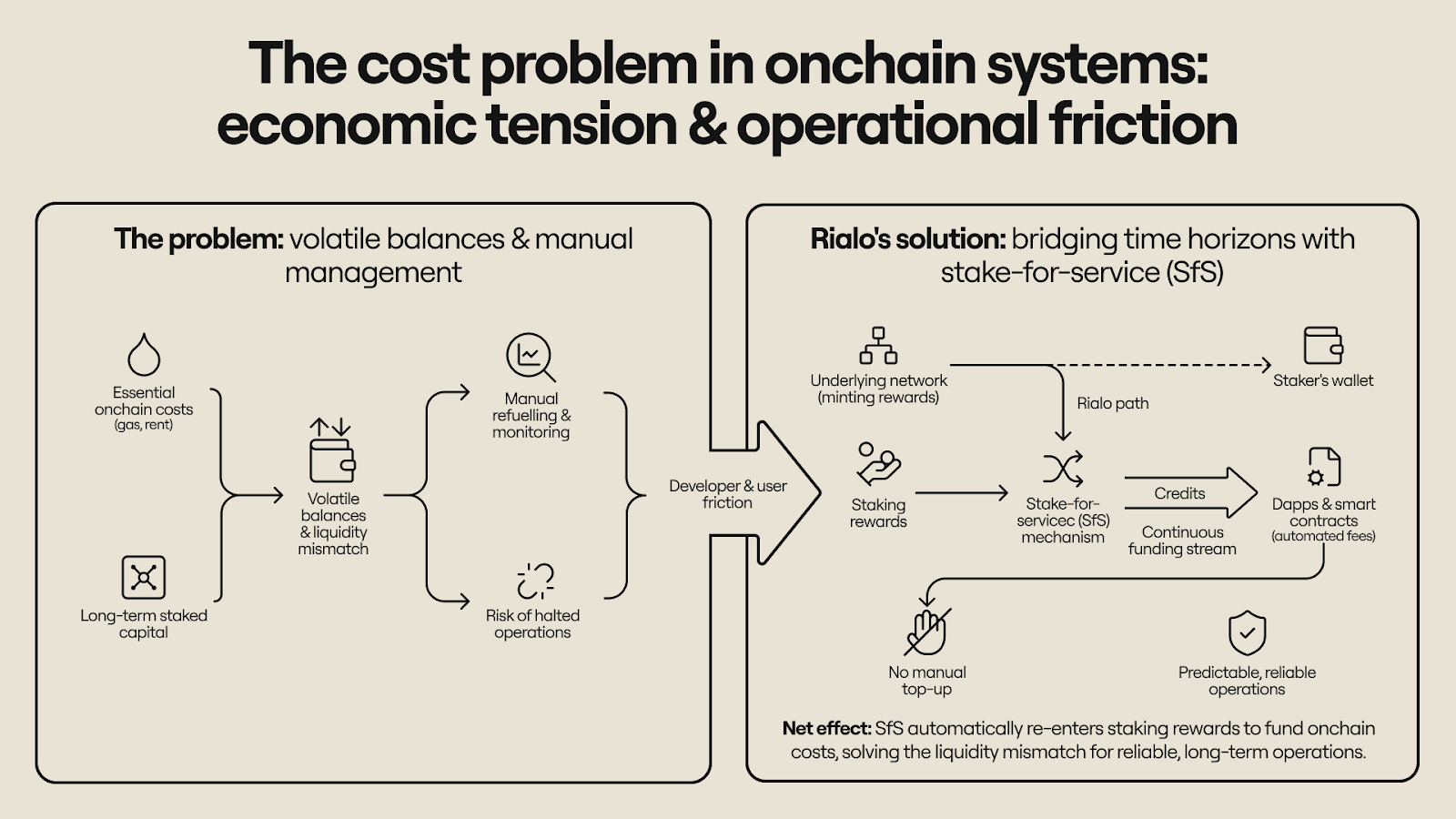
Every onchain system faces a basic economic tension. Blockchains charge gas, maintain state rent, and meter throughput to prevent spam and resource exhaustion. These are essential costs, but they also introduce friction because users and contracts must maintain volatile balances (that fluctuate in both price and quantity) just to stay operational. The result is an environment where long-lived applications and long-term capital cannot reliably fund the short-term fees required to keep the system running.
Developers experience this as operational float. A dapp must keep a small treasury of native tokens to cover its recurring fees, or risk halted operations when balances run dry. The same problem extends to smart contracts that perform scheduled or subscription-based tasks. Each one must be refueled periodically, a process that feels foreign to web2 developers who are used to recurring billing models and credit-based systems.
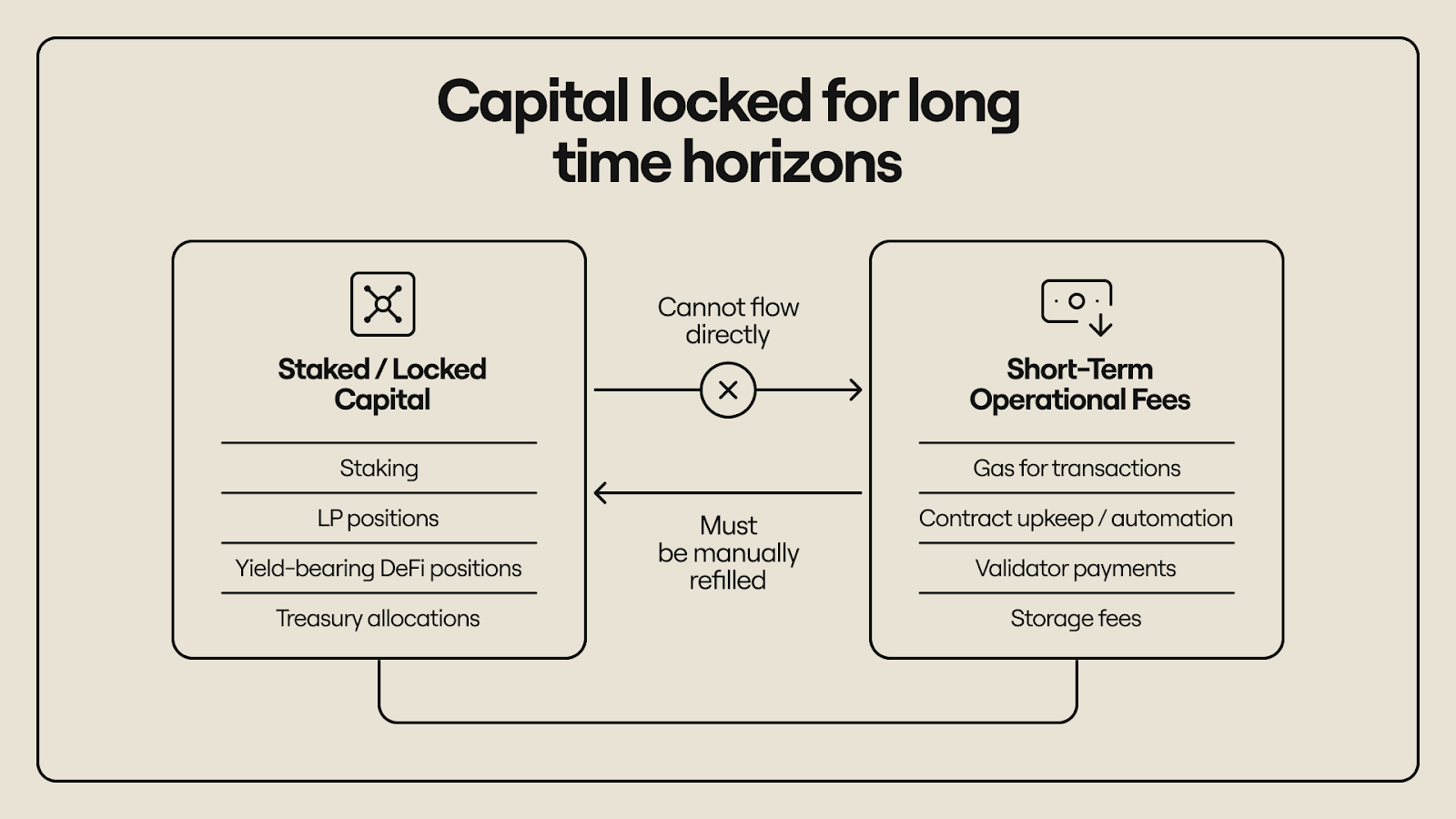
Users experience the same friction from the opposite side. They may have long-term capital staked or locked in yield-bearing positions, but that capital cannot directly fund their ongoing activity. The result is a mismatch between long-term wealth and short-term liquidity, creating a constant need to rebalance, top up, and monitor balances.
Onchain systems need a mechanism that can bridge these time horizons. The underlying networks are already capable of minting and distributing rewards at predictable intervals. The problem is that these rewards currently flow in only one direction, back to the staker’s wallet. They do not automatically re-enter the economy to fund productive activity. Rialo’s Stake-for-Service (SfS) mechanism changes that.
Concept: Paying for onchain costs from staking yield
Stake-for-Service is a unique position type in the Rialo protocol that allows staking rewards to flow directly into service payments. Instead of paying gas or storage fees from a volatile wallet balance, users or contracts can commit a fraction of their staking yield to cover those costs automatically.
When a user creates an SfS position, they specify a routing fraction,
representing the percentage of future staking rewards they want directed toward service payments. Those rewards do not pass through the user’s account. Instead, they are routed to a special component called the ServicePaymaster (SPM), which mints an equivalent quantity of service credits. These credits act like programmable vouchers. They can be spent on gas, storage, or scheduled executions anywhere within the Rialo ecosystem.
This simple routing rule transforms staking into a live funding stream. The staking principal continues to secure the network and earn rewards, but part of the yield continuously circulates back into the system as payment for useful work. The user never needs to claim rewards or top up their balance manually. They can simply specify a desired service budget, expressed as a fraction of yield, and let it fund their activity indefinitely.
In practical terms, the mechanism resembles an airline miles or credit-card reward system. Instead of distributing staking rewards as spendable tokens, the network converts them into in-kind credits redeemable for onchain services. These credits retain economic equivalence to the underlying token (since service providers can redeem them for RLO payouts), but they behave differently at the user level. They are non-transferable outside the service context and cannot be speculated upon. This design ensures that rewards remain productive rather than extractive.
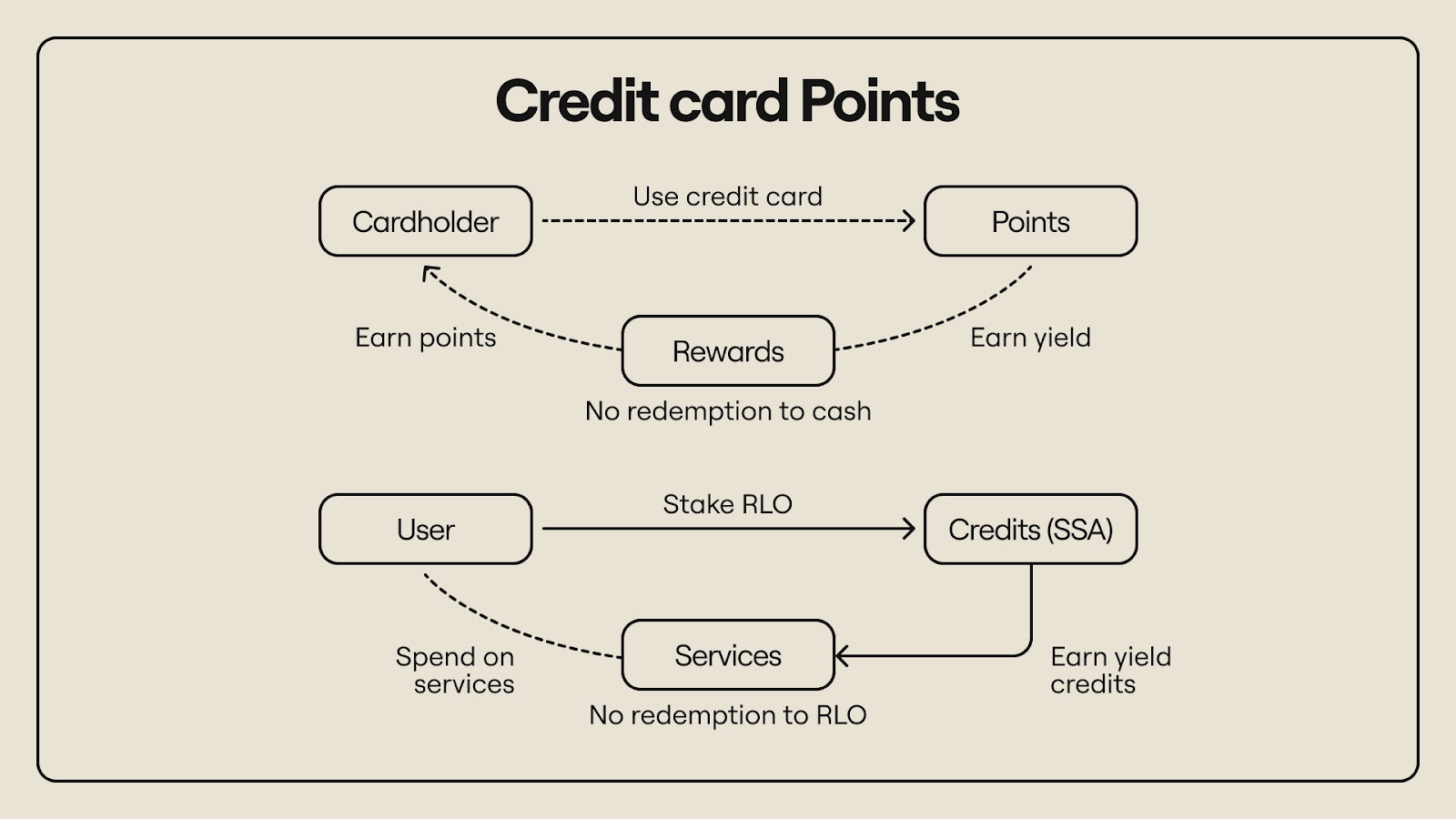
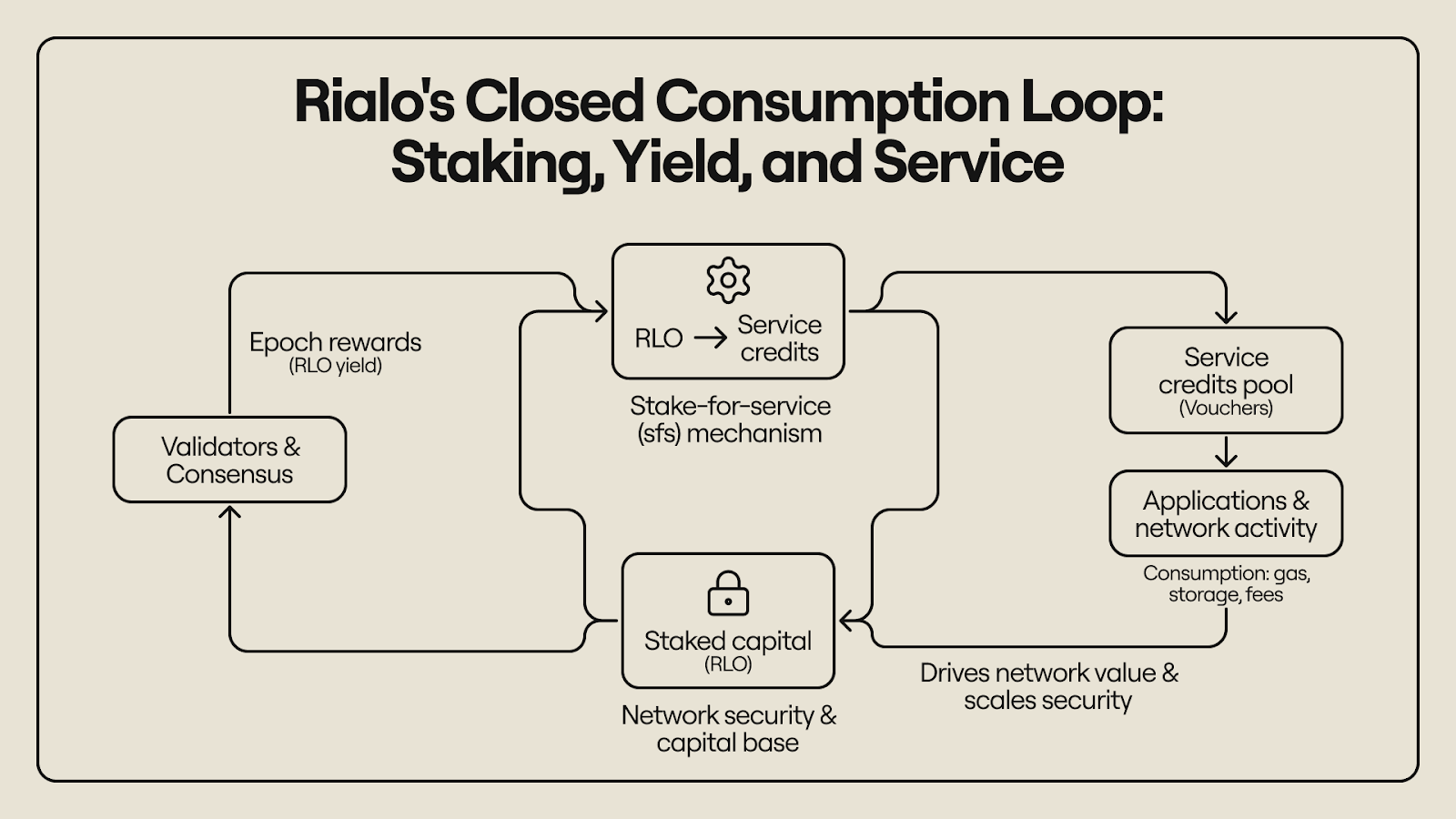
The intuition behind SfS is straightforward. Yield should not only accumulate but also circulate. In most systems, staking rewards simply build up until a user manually moves them. SfS instead turns a portion of that yield into a live funding stream for onchain services. This creates a closed loop between long-term capital and short-term consumption, ensuring that staking contributes directly to ongoing network activity.
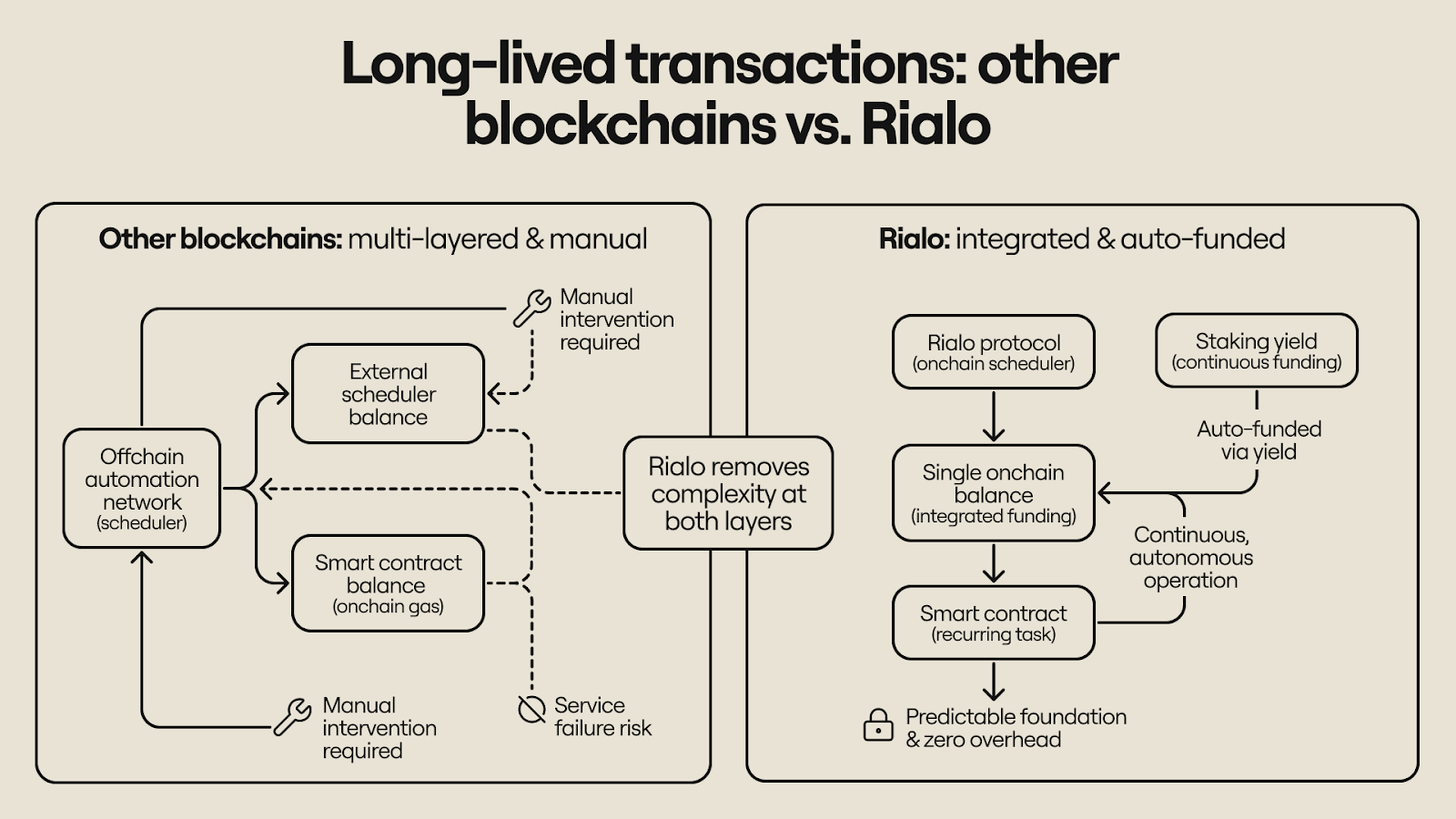
This funding model also resolves the liquidity and operational issues faced by long-lived contracts performing recurrent tasks or transactions. On most blockchains, subscription-based actions depend on offchain automation networks that charge their own fees and require their own funding balances, separate from the native tokens needed to pay onchain gas. Developers must keep both balances topped up to keep these contracts running, which creates constant overhead and introduces new points of failure.
Rialo removes this complexity at both layers. Scheduling itself is a native onchain feature of the protocol, and Stake-for-Service extends that model by allowing the payments for scheduled execution to be funded onchain as well, directly from staking yield. Instead of maintaining multiple balances and refilling them repeatedly (a form of double marginalization), a contract can sustain its recurring activity through a single, integrated onchain funding mechanism. This is a structural advantage unique to Rialo’s architecture and forms a predictable foundation for the application types and use cases explored later in this article.
The architecture of Stake-for-Service
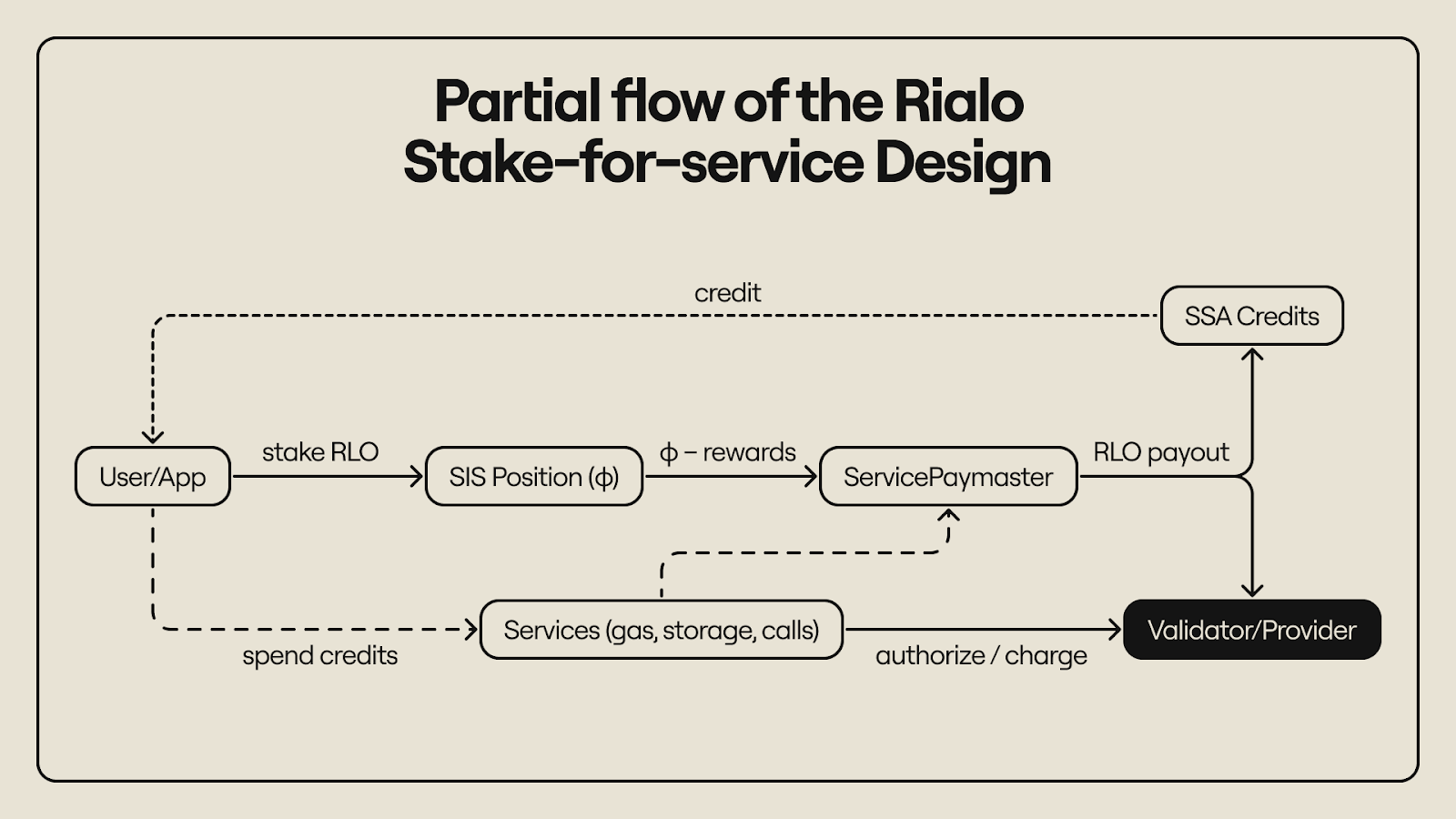
The Stake-for-Service mechanism operates through three primary components: SfS positions, the ServicePaymaster, and the validator-provider network that executes and fulfills service consumption.
SfS Positions
An SfS position represents a staker’s decision to allocate part of their future rewards toward network services. Each position is defined by three attributes:

This aggregated reward is minted directly to the ServicePaymaster, bypassing user custody. The remaining share follows the standard vesting path to the staker’s account.
The ServicePaymaster (SPM)
The ServicePaymaster acts as the accounting hub that converts routed rewards into usable service credits. When it receives the aggregated rewards, it mints an equivalent quantity of credits, maintaining a 1:1 backing against future RLO payouts.
These credits can be spent by users or contracts in the same contexts where they would otherwise pay gas or storage fees. When a transaction consumes credits, the SPM authorizes a corresponding payout of RLO to the validator and service provider that fulfilled that work.
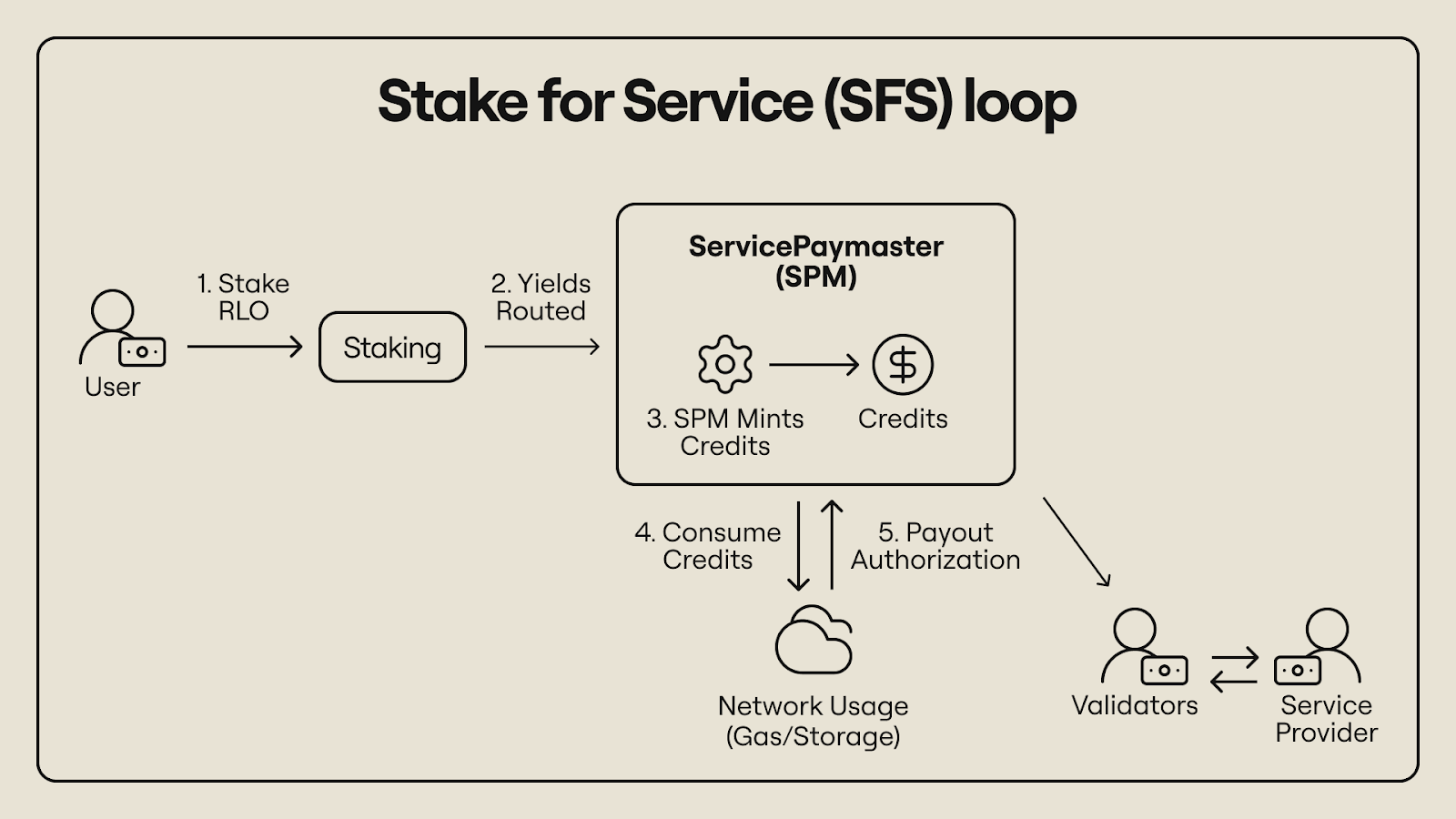
The paymaster closes the payment loop.
1. Users stake RLO.
2. Staking yields are partially routed to the SPM.
3. The SPM mints credits.
4. Credits are consumed during network usage.
5. Validators and providers receive the equivalent RLO payouts.
This architecture preserves the same reward distribution that would exist if users manually paid with RLO. It introduces programmability and predictability into the process.
Continuous flow and state accounting
In implementation, the SPM maintains an internal ledger that tracks each user’s outstanding credit balance and consumption history. Because staking rewards are epoch-based, the credit supply refreshes at predictable intervals. A user with sufficient staked principal and an appropriate routing fraction can effectively operate indefinitely, as long as their yield covers their spending rate.
This system also simplifies network accounting. The SPM serves as a centralized clearinghouse for service payments, making it easier for Rialo to integrate new classes of payables, such as oracle updates, scheduled tasks, or offchain compute proofs, without redesigning fee mechanisms for each.
Integration with Rialo economics
SfS is not a standalone feature. It extends Rialo’s broader approach to aligning capital formation and service consumption. Validators already receive epoch rewards denominated in RLO, and applications already interact with paymasters for gas abstraction. SfS unifies these flows by embedding them into the staking system itself.
This integration means that network activity no longer competes with staking for liquidity. In traditional systems, staking locks up tokens that might otherwise be used for fees, creating a trade-off between security and utility (more staked tokens means higher security, while more liquid tokens means higher utility, throughput, and DeFi usage). In Rialo, staked capital continues to secure the network while the yield it produces funds ongoing activity, allowing both security and utility to scale together.
What are the benefits of Stake-for-Service?
Stake-for-Service is more than a new way to pay for gas. It reshapes how users, developers, and validators interact with the network. By allowing staking yield to fund onchain activity directly, it simplifies user onboarding, stabilizes long-term contract operations, and expands the practical utility of RLO across the ecosystem.
We explore these benefits and what they enable in further detail below.
Gasless onboarding for users
One of the immediate benefits of Stake-for-Service is frictionless user onboarding. New users often encounter their first transaction fee before they even understand how to acquire tokens. With SfS, wallets or applications can stake RLO on behalf of users and route a portion of the resulting yield toward their initial activity. The user can begin transacting immediately, funded by yield rather than by purchasing tokens on an exchange.
This model introduces a gasless onboarding pathway that still preserves validator revenue. Instead of eliminating fees, it pre-pays them from a sustainable source.
Recurring transactions and long-lived contracts
Contracts that perform scheduled or subscription-based actions, such as automated swaps, vault rebalances, or governance tasks, can maintain their operations indefinitely by staking enough RLO to cover expected service costs through yield. Because staking rewards accrue predictably, contracts can estimate their operating budget with high confidence.
This enables new classes of self-funding contracts that do not require manual top-ups. A developer can deploy a service, endow it with a stake, and allow it to sustain itself autonomously for years.
Dynamic NFTs that automatically update
Consider an NFT project that wants to update based on real-world migration patterns or phases of the moon. On Rialo, the NFT contract can point to the data API and, during minting, direct a proportion of the proceeds to an SfS account. Then the staking rewards can cover the contract's dynamic updates in perpetuity. An NFT that “lives forever” permissionlessly, funded from the start.
Bulk sponsorship of user activity
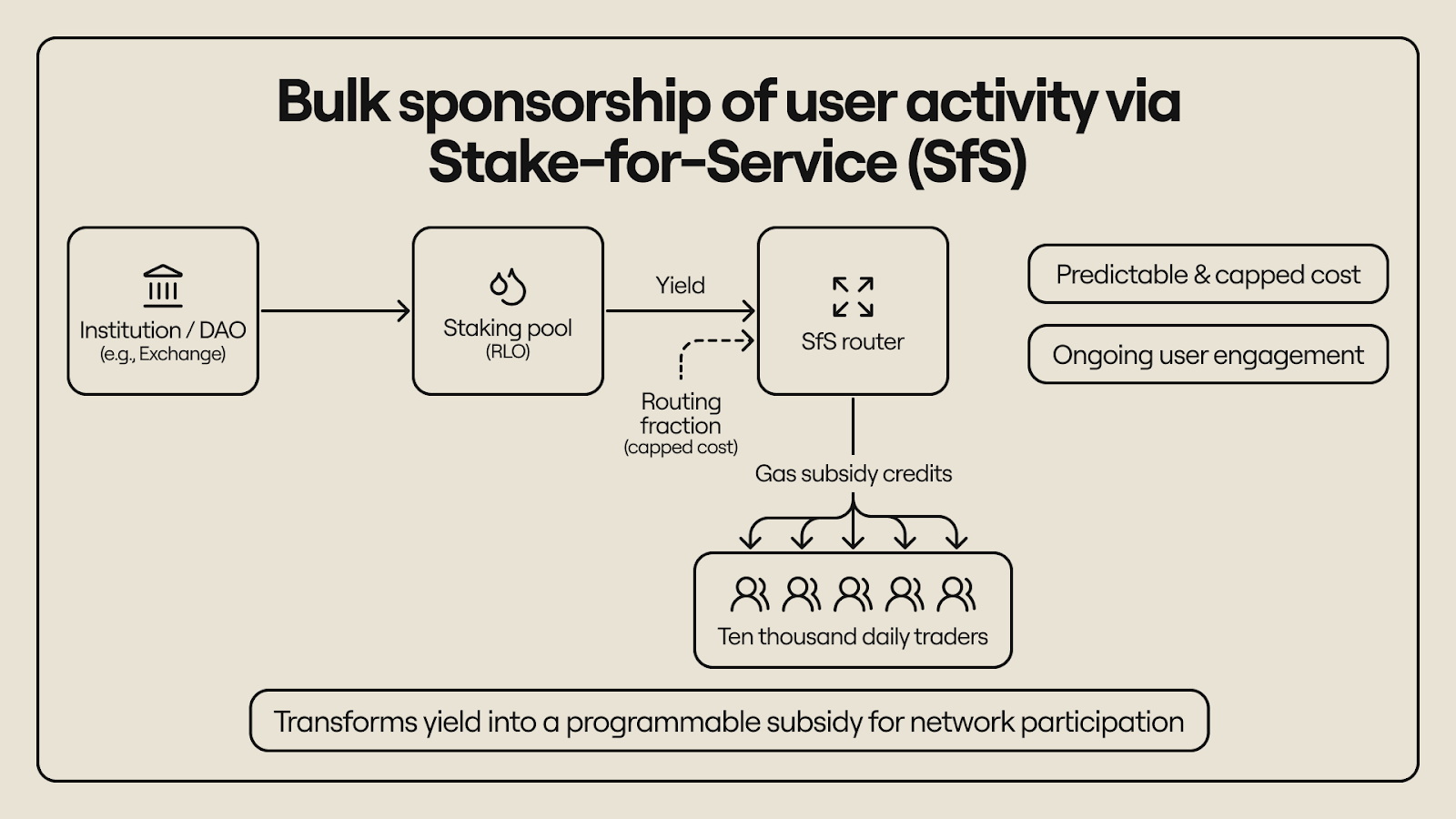
Institutions or DAOs can also use SfS to sponsor large numbers of users in bulk. For example, an exchange could stake RLO and route its yield to cover gas for ten thousand daily traders. The cost is predictable and capped by the routing fraction, while the benefit is ongoing user engagement.
This bulk sponsorship mechanism replaces ad hoc rebate or reward systems with a native, protocol-level primitive. It transforms staking yield into a programmable subsidy for network participation.
Additional utility for RLO
Beyond improving user experience, SfS increases the intrinsic utility of RLO itself. In most staking systems, token value is determined solely by yield expectations. SfS adds a new use case. RLO becomes not only a yield-bearing asset but also a consumable budget for network services.
The more applications integrate SfS, the greater the demand for RLO staking, because staking directly translates into usable throughput. This dynamic strengthens alignment among token holders, validators, and developers, aligning incentives with productive network activity rather than speculative trading.
Programmatic predictability
For developers and treasuries, SfS introduces predictability into cost management. Instead of holding volatile token balances to pay for future activity, they can fix a routing fraction that guarantees a steady service budget denominated in credits. Because both the reward rate and the routing parameters are transparent onchain, cost modeling becomes straightforward.
A DAO treasury, for instance, can allocate ten percent of its staking rewards to service payments and know that its contracts will continue functioning without manual intervention. This predictability reduces operational risk and simplifies budgeting for governance.
Stake-for-Service as an economic policy mechanism
Blockchains traditionally treat issuance rules as security levers. They modulate inflation or reward schedules to maintain validator participation and staking ratios, but they rarely use those levers as macroeconomic tools. Rialo’s Stake-for-Service mechanism introduces a new possibility: direct, bounded demand stimulus.
The Stimulus Parameter
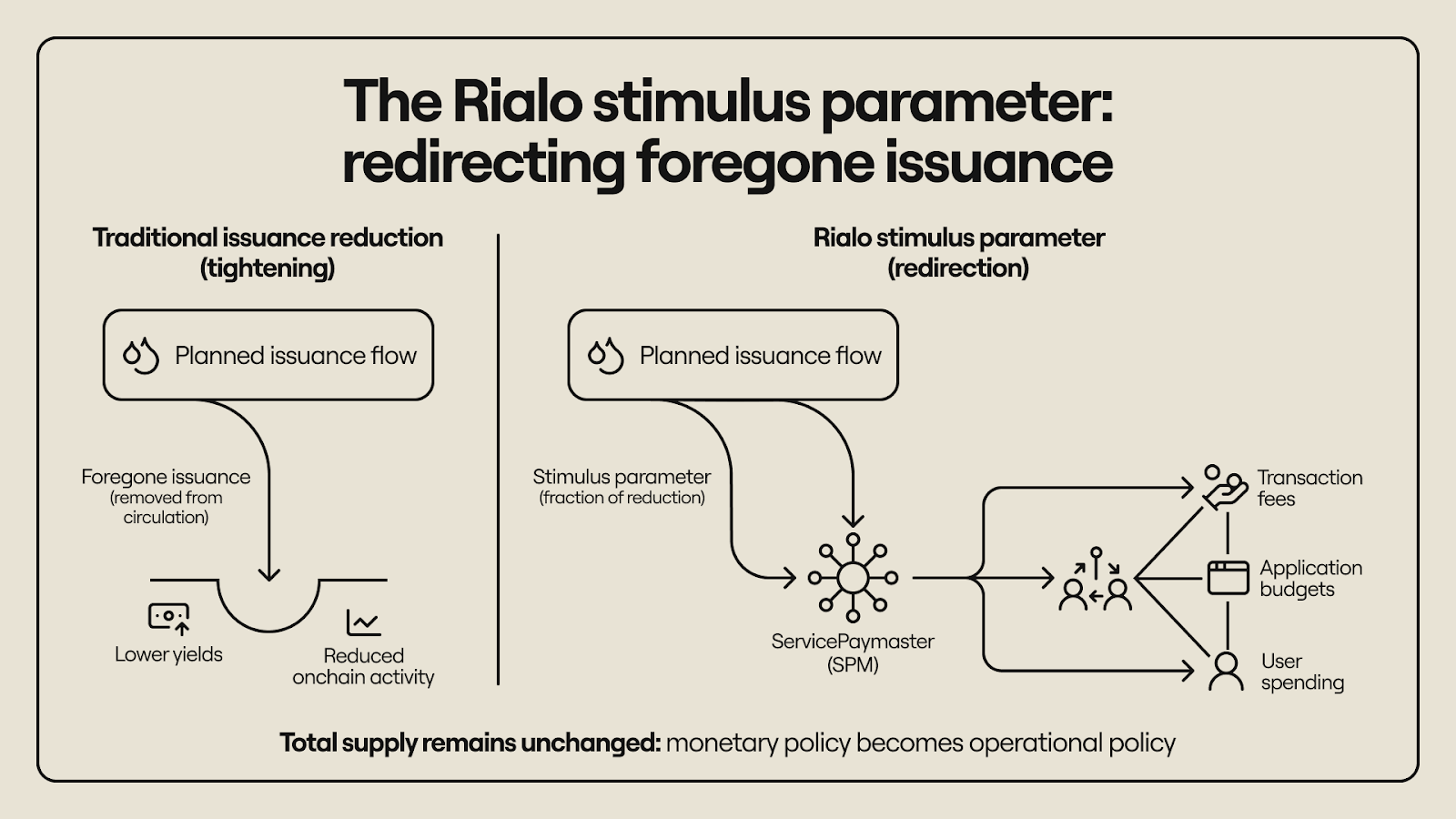
In traditional economics, central banks adjust interest rates or money supply to stimulate demand during slowdowns. Rialo’s approach achieves a similar effect onchain. Instead of printing additional tokens, governance can redirect a fraction of reduced issuance into service credits that fund real network activity. The total supply remains unchanged, but a larger share is directed toward productive use. In effect, Rialo turns monetary policy into operational policy–directly boosting utilization rather than merely adjusting yields.
Formally, Rialo governance can specify a stimulus parameter that redirects a fraction of any planned issuance reduction into the ServicePaymaster:

When a network reduces issuance, it effectively tightens monetary policy by lowering the rate at which new tokens enter circulation. This stabilizes long-term value but also slows the flow of new liquidity into the system. Lower staking yields mean less periodic income for validators and delegators, which in turn reduces the amount of yield circulating back into user spending, application budgets, and transaction fees. The result can be a gradual decline in onchain activity, even when network security remains strong.
Rialo resolves this by redirecting a small, controlled portion of the foregone issuance into the ServicePaymaster. This keeps the network revenue-neutral at the macro level while stimulating utility at the micro level. In practice, the network can offset temporary slowdowns in transaction volume or application growth by providing additional service credits to active participants. Because these credits can only be spent within the network, they increase utility without causing external inflation.
What is the economic rationale for Stake-for-Service?
Traditional monetary systems distinguish between wealth effects, which change total capital, and substitution effects, which change relative yields. Reducing issuance can make application yields look more attractive relative to staking, encouraging participation. But it can also shrink the overall pool of spendable tokens, suppressing demand.
SfS allows Rialo to resolve this ambiguity. By routing a small, controlled portion of issuance into service credits, governance can stimulate usage directly without undermining long-term token value. The mechanism acts as a thermostatic feedback loop: when network activity cools, credits flow in, and when activity heats up, the routing parameter contracts.
Targeting specific onchain activities with Stake-for-Service
Because the ServicePaymaster distinguishes between categories of onchain activity, Rialo can apply the stimulus selectively. Governance could, for example, direct extra credits toward oracle updates, onchain automation, real-world asset settlements, or any domain where increased throughput benefits the ecosystem as a whole.
This precision turns SfS into a genuine economic instrument. Instead of relying on temporary incentives, Rialo can promote specific behaviors through native credit routing.
Turning yield into flow across the network economy
Stake-for-Service extends beyond the immediate problem of gas payment. It represents a shift in how we think about yield, liquidity, and network utility.
In traditional finance, yield is a passive return, a measure of how fast capital grows. In decentralized systems, this model creates friction because yield remains idle until claimed. SfS converts yield into flow–a continuously refreshed stream that feeds back into productive use.
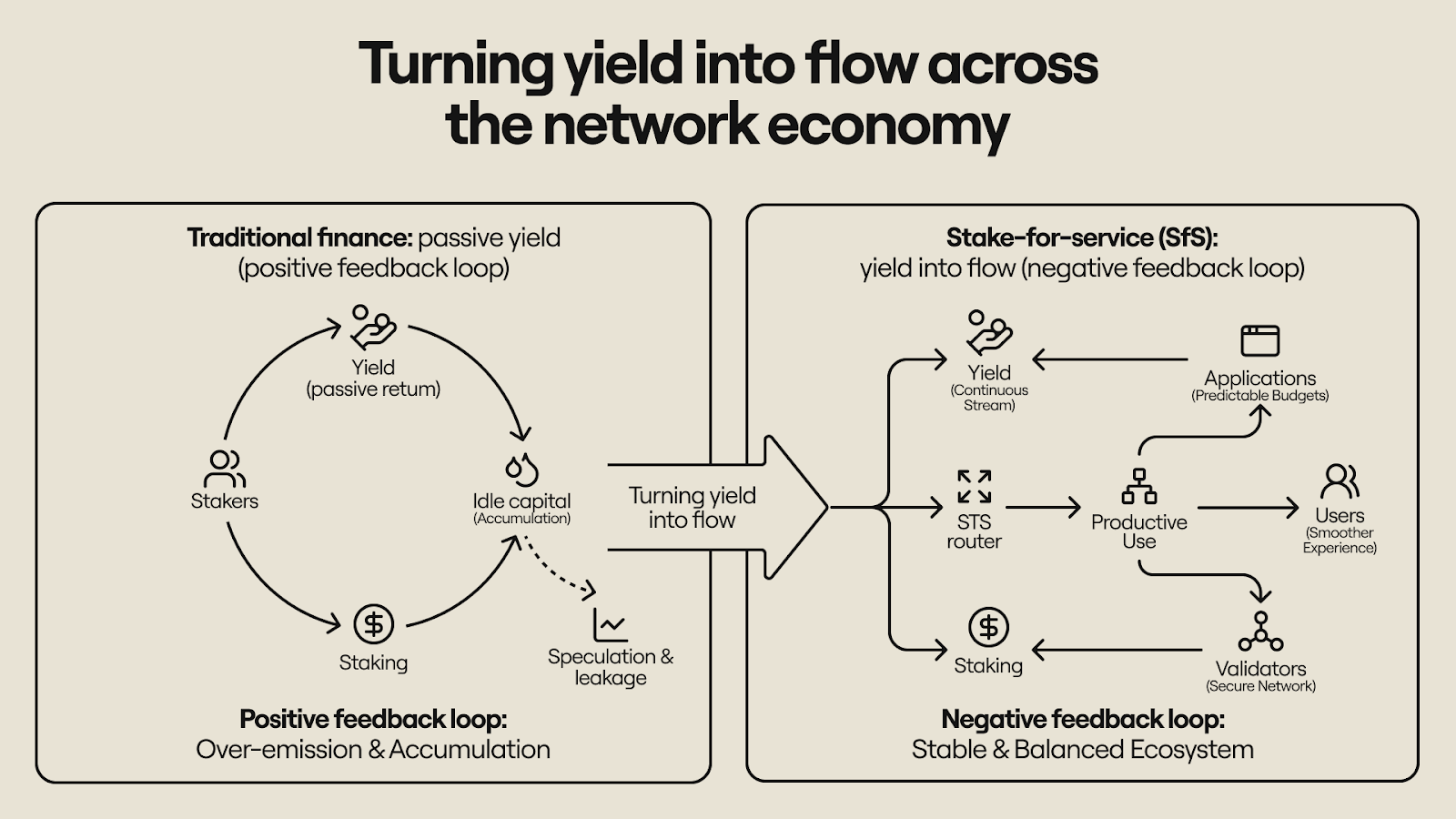
This design aligns incentives across all layers of the stack. Stakers earn yield, validators secure the network, applications gain predictable budgets, and users enjoy smoother experiences. There is no wasted liquidity. Every token contributes simultaneously to security and utility.
From a systems-theoretic perspective, SfS introduces negative feedback where crypto-economics previously had only positive loops. Instead of over-emitting rewards that accumulate in wallets and later leak into speculation, Rialo redirects part of that energy into immediate economic activity. The result is a more stable and internally balanced ecosystem.
Exploring the future possibilities of Stake-for-Service
The SfS model opens the door to a wide range of innovations. A few of the most promising directions are outlined below.
1. Self-maintaining protocols: Protocols can maintain their own infrastructure costs perpetually by staking a portion of their treasury and routing yield into upkeep. This eliminates the need for periodic fundraising or token inflation to cover expenses.
2. Composable paymasters: Other chains or rollups could integrate Rialo’s SPM as a shared service layer, allowing their users to pay cross-network fees through yield. This could unify fragmented ecosystems under a common credit standard.
3. Real-world subscriptions: In hybrid systems bridging onchain and offchain services, SfS could fund recurring API calls, data feeds, or compute tasks, anywhere that continuous payment is required but volatility is undesirable.
4. Institutional adoption: For enterprises exploring blockchain integration, predictable cost management is critical. SfS provides a familiar budgeting model that mirrors traditional subscription systems, easing the transition into onchain operations.
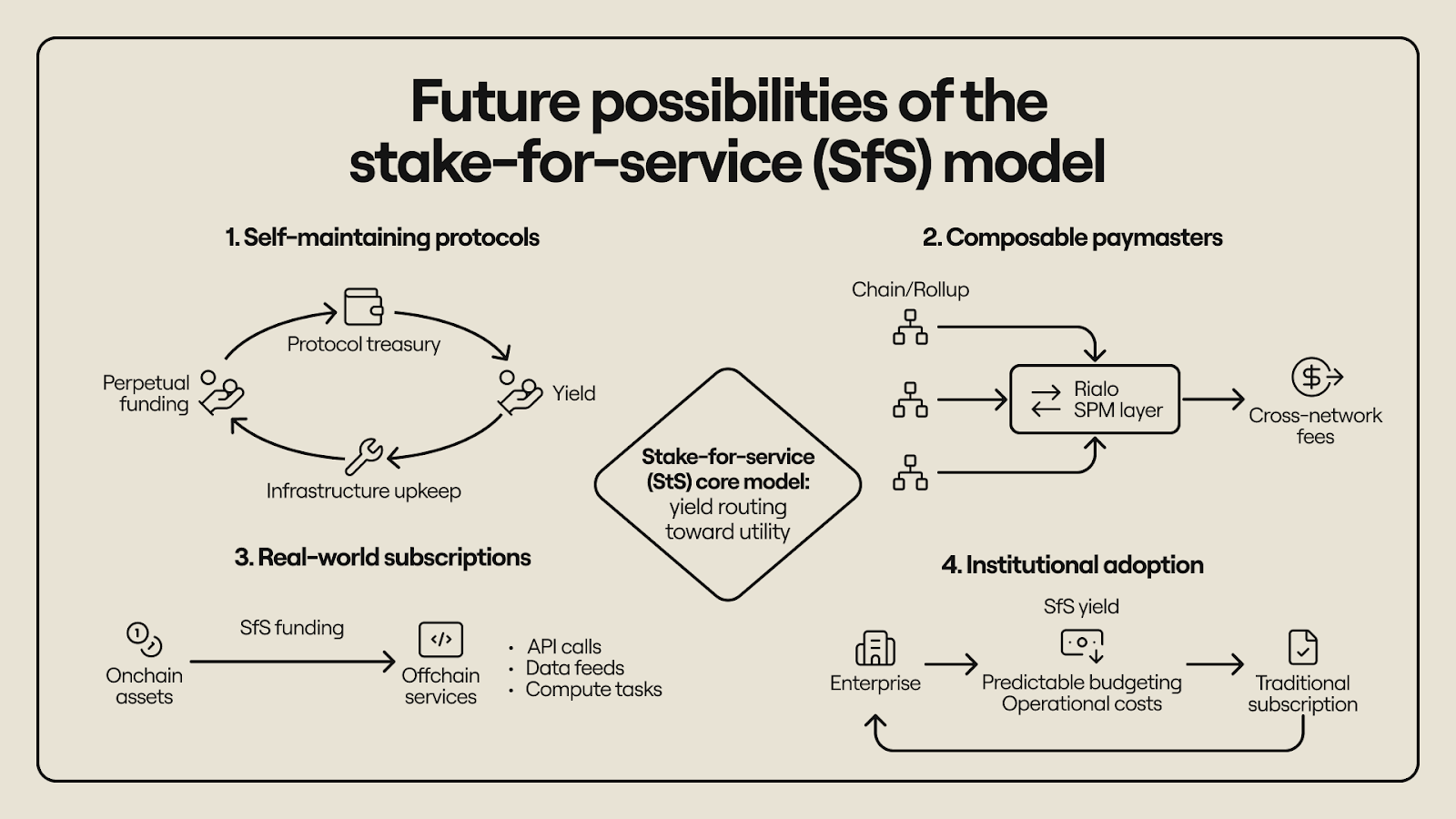
Each of these extensions follows naturally from the core principle of routing yield toward utility rather than idle accumulation.
Towards a self-sustaining onchain economy
Stake-for-Service transforms staking from a passive savings mechanism into an active payment channel. It connects the supply of capital to the demand for computation in a single continuous circuit.
In Rialo, staking is not just about earning yield; it is about powering the network itself. By automatically allowing yield to fund gas, storage, and other onchain services, SfS dissolves the line between investors and users. Every staker becomes a contributor to network vitality, and every transaction feeds back into the same pool of productive capital.
The broader vision is a self-sustaining onchain economy where systems fund themselves through their own success. Contracts no longer rely on external subsidies, and protocols can operate autonomously for decades.
As the crypto industry moves beyond speculation toward genuine utility, mechanisms like Stake-for-Service will define the next era of network design. Rialo demonstrates that economic architecture can evolve alongside technical architecture and that we can build systems where liquidity, yield, and activity reinforce one another.